Effort estimation in project management is predicting how much work a task or project will take before it starts, in hours or in story points. An estimate becomes useful only when it is compared with the actual effort afterwards: the gap between planned and actual shows whether plans can be trusted and where the next plan must change.
In practice, requirements change, new tasks emerge and some work turns out to be more complex than expected. As a result, the initial estimate may differ significantly from the actual time spent.
To understand whether a project is progressing as planned, it is important to estimate the workload before work begins and track actual time spent throughout the project.
Why Project Estimation Matters
An estimate helps answer several key questions before work starts:
- how much effort the project is likely to require;
- which specialists need to be involved;
- whether the proposed deadlines are realistic;
- whether the available resources are sufficient.
The more accurate the initial estimate, the easier it is to plan team capacity, align expectations with the client and reduce the risk of missed deadlines. However, even a well-prepared estimate cannot guarantee that a project will follow the original plan exactly.
Why Estimation Alone Is Not Enough
Once a project is underway, it is important to know both how much time was expected to be spent and how much has actually been used. Without tracking actual time, a manager may only discover that a project has gone over budget in terms of effort once the work is complete, when there is little opportunity to correct course.
Comparing planned and actual figures makes it possible to identify deviations earlier and take action:
- redistribute the workload;
- revise deadlines;
- adjust the scope of work;
- identify tasks that have proved significantly more complex than expected.
Historical Data Makes Each New Estimate More Accurate
Most modern project management approaches recognise the value of using previous results when estimating future work. When a team consistently records both planned estimates and actual time spent, it gradually builds its own body of data. This can help the team:
- estimate similar tasks more accurately;
- account for work that was previously overlooked during planning;
- understand the team’s actual delivery capacity;
- forecast timelines for new projects based on previous experience rather than assumptions alone.
Each completed project provides useful data for future planning.
Story Points and Hour-Based Estimation
Many teams use Story Points to estimate tasks based on their relative complexity. Unlike estimates in hours, Story Points do not represent the expected time required to complete a task. Instead, they indicate how complex one task is compared with another.
For example, fixing a minor issue might be estimated at 1 Story Point, developing a new section at 5 Story Points, and implementing a complex integration at 13 Story Points. This approach makes it easier to compare tasks when it is difficult to predict in advance exactly how many hours each one will take.
However, Story Points do not show how much time was actually spent. This is why teams often use them alongside effort estimates and time tracking. Together, these approaches support both forward planning and analysis of the results after the work is complete.
| Criterion | Story points | Hours |
|---|---|---|
| What it measures | Relative complexity of one task against another | Expected working time |
| When to use | Sprint planning in a stable team that has estimated together before | Client quotes, budgets, timesheets, anything invoiced or paid by the hour |
| Who estimates | The whole team, by agreement, before the sprint | The person who will do the work, or the lead with them |
| How to compare with actuals | Indirectly: points completed per sprint (velocity) against points planned | Directly: hours logged on the task against hours estimated |
| Typical pitfalls | Points drift into hours in people’s heads; velocity compared between teams | Optimism on unfamiliar work; estimates set by whoever needs the deadline rather than whoever does the work |
| Best with | Hours logged alongside, so the team sees what a point costs | Story points alongside, for planning when hours cannot be known yet |
A worked example: 8 hours planned, 13 logged
A developer estimates a task at 8 hours: build a monthly sales report export for a client. Time is logged on the same task as the work happens, and by the end of the week it shows 13 hours spent.
In a ten-minute retrospective, the team finds where the 5 extra hours went:
- 3 hours on the output format. The client’s accountant needed a specific file layout that nobody had asked about. The estimate was right for the work described and wrong for the work needed. The lesson is a question, not a number: "Who reads the output, and in what format?" now goes into the checklist for every export task.
- 2 hours on testing with real data. The estimate had not included testing at all. Testing is now a separate line in every estimate.
The next similar task is estimated at 10 hours: 8 for the work and 2 for testing. The format is agreed with the client before work starts, so it adds no hours. The task comes in at 11, and the gap shrinks from 5 hours to 1.
The estimate did not improve because the developer became faster. It improved because the hours sat next to the estimate, so the gap had a cause attached to it. That comparison is what the time tracking and timesheets module keeps in one place; the kanban bottlenecks article shows the same comparison across a whole board.
How Weenvo Helps
In Weenvo, task estimation and time tracking are integrated within the project, allowing teams to plan workloads, monitor actual time spent and analyse project results.
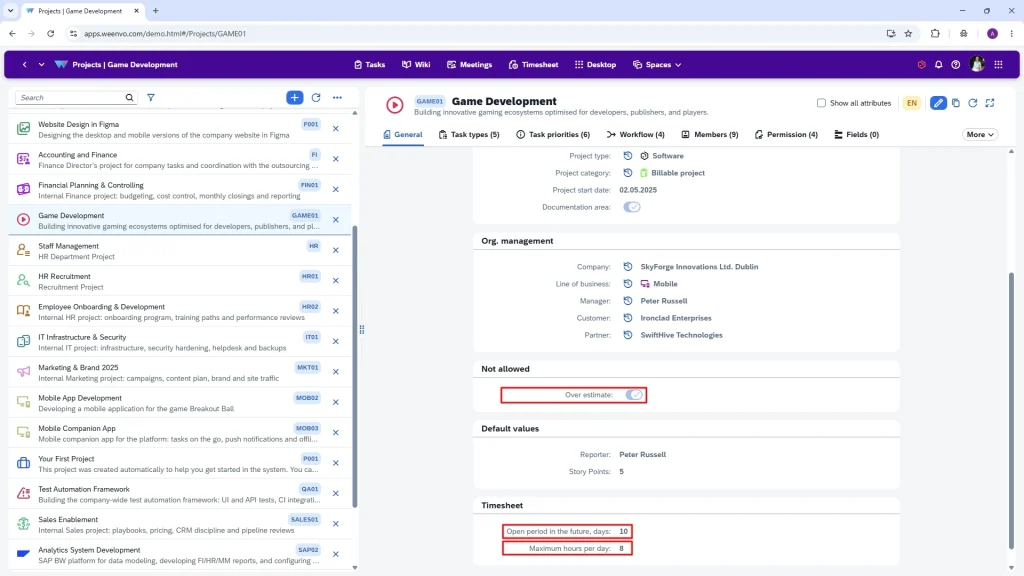
Under Time Tracking, project settings can define rules for logging time, including:
- how many days after a task is completed users can still record time spent on it;
- the maximum number of hours a user can enter in their timesheet for a project on a single day.
Under Not Allowed, managers can also prevent users from logging more time than the task’s planned estimate.
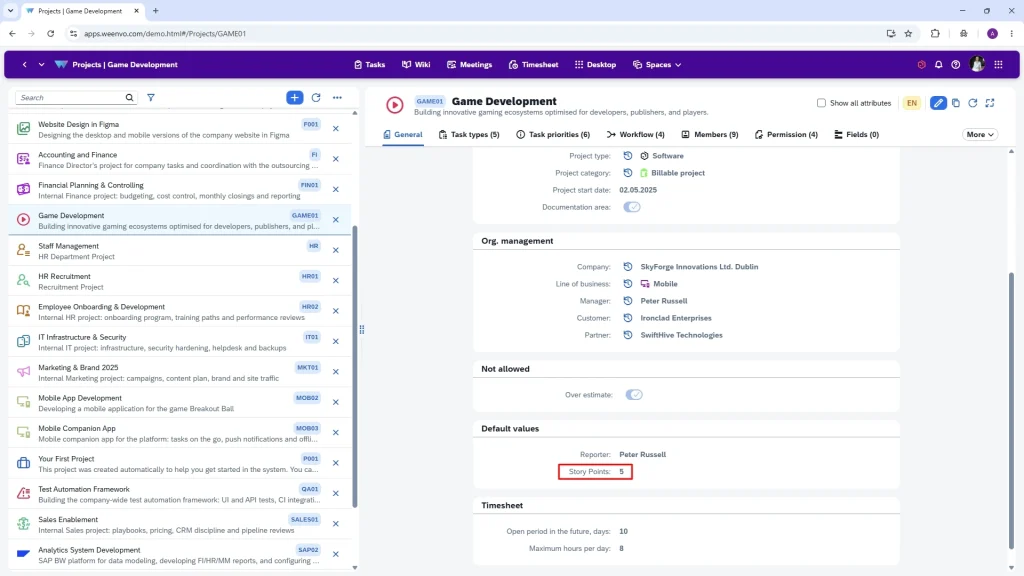
For task complexity estimation, Weenvo uses Story Points. A default value can be set in the project settings for new tasks and adjusted for individual tasks when needed.
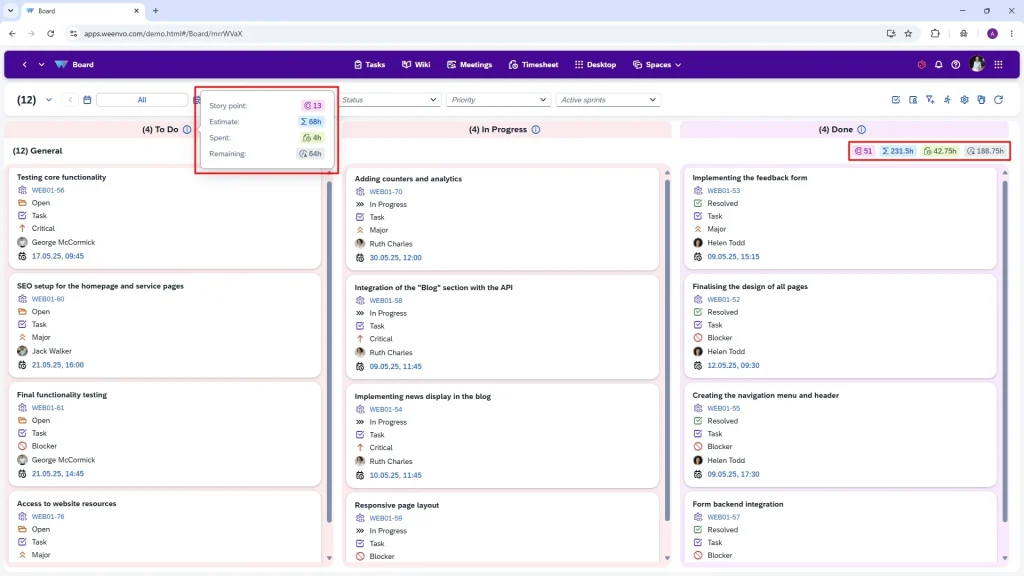
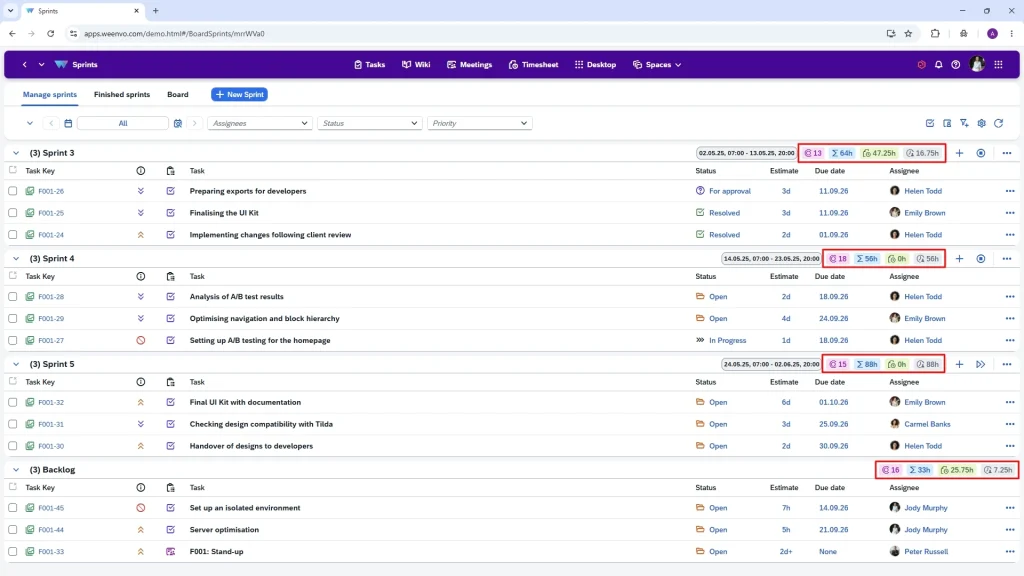
Weenvo uses four interconnected metrics to estimate and monitor project work:
Story Points — the relative complexity estimate for a task;
Estimate — the planned amount of effort;
Spent — the actual time recorded;
Remaining — the amount of work still left to complete.
Together, these metrics show the planned effort, actual time spent and remaining work for each task, while Story Points provide a relative measure of its complexity.
These metrics are available throughout the areas of the system where they are relevant, allowing teams to analyse project work in different views without losing access to key data. For example:
In Boards — by task groups and columns:
- In Sprints — for each sprint and the backlog:
- In all Tasks views: Details, Calendar, List, Table, Timeline and Board:
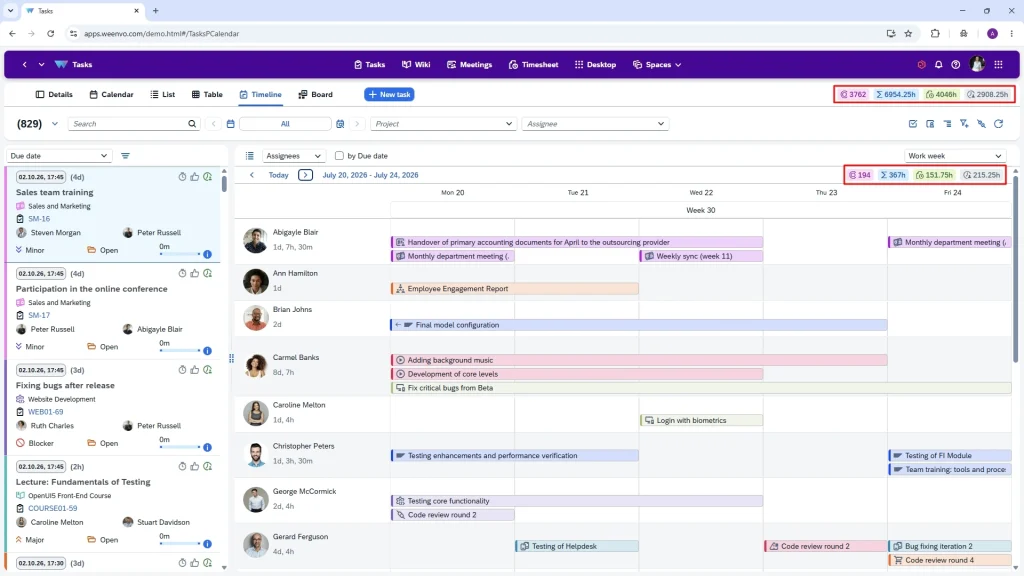
By combining Story Points, effort estimates, actual time tracking and project analytics, Weenvo helps teams do more than monitor work in progress. It also provides the data needed to improve future planning. Each completed project provides useful data for future planning and helps the team make better-informed decisions.
The [project and task management](https://weenvo.
FAQ
What is effort estimation in project management?
Effort estimation is predicting how much work a task or project will take before it starts, in hours or in story points. It is used to plan capacity, set deadlines and agree scope with the client, and it becomes reliable only when the actual effort is logged and compared with it afterwards.
What is the difference between effort and duration?
Effort is the working time a task needs, for example 8 hours. Duration is the calendar time between start and finish, for example three days, because the person also has other tasks, waits for an answer or works part-time. A plan built on effort alone will miss its dates; one built on duration alone will not know what the work cost.
Story points or hours: which is better?
Neither on its own. Story points suit sprint planning in a stable team and avoid false precision on unfamiliar work. Hours suit anything quoted, budgeted or invoiced, and can be compared directly with logged time. Most teams that bill clients use both: points to plan the sprint, hours to measure it.
How do you compare estimated and actual effort?
Log the actual time on the same task that carries the estimate, then compare at three levels: per task to find the ones that were misjudged, per person to see whose estimates run optimistic, and per project to decide whether the overall plan still holds. Compare every week, not at the end.
What is a good estimation accuracy?
There is no fixed target; the useful measure is whether the gap is shrinking and whether its causes are known. A team whose actuals land within about 20% of estimates on familiar work is planning well; on new kinds of work a bigger gap is normal, as long as the next estimate for that kind of work uses it.
Try the Weenvo demo or start for free.